
Card games · Real-world rules
Satti rules — build each suit from seven
ستی
Also called Sevens, Saat, Fan Tan.
Satti, or Sevens, is a card game about building each suit outward from its seven and emptying your hand. Add the next card in a row or start another suit with a seven. This guide selects an ace-low family layout; other Sevens versions place the ace above the king or choose a different opening card.
At a glance
- Players
- 3–6
- Suggested age
- 7+ with guidance
- Allow about
- 15–25 minutes
- Where
- Indoor table, Clean floor mat
- Equipment
- Standard 52-card pack · Space for four suit rows
Jump to a rule
What you need
- Use one ordinary pack with jokers removed. Leave four lanes on the table, one for each suit. For a small table, you can overlap cards after everyone has seen the move, but keep the two open ends of every row visible.
- The game needs attention to rank and suit rather than quick hands. A younger player can arrange their hand openly during a practice game, with the group helping them find legal moves before a hidden-hand round.
Setup
- Shuffle and deal the whole pack clockwise. With some group sizes, players receive different numbers of cards. Do not discard the spare cards: they may be needed to connect a suit's sequence.
- For our selected house setup, the seven of hearts starts. Its holder places it and play continues clockwise. Write the opening suit down if your family usually begins with diamonds or lets the player left of the dealer choose any seven.
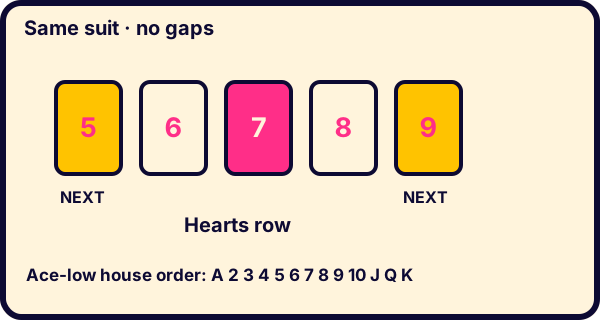
- Use this sequence on every row: A, 2, 3, 4, 5, 6, 7, 8, 9, 10, J, Q, K. The ace is below the two in this guide. There is no wrapping from king back to ace.
How to play
- At your turn, inspect the open ends of each suit. You may place a seven to begin its row, or the next card immediately above or below an existing end. You play one card per turn.
- Check both rank and suit. If the hearts row shows only seven, a six of hearts or eight of hearts fits. A six of spades needs its own spades seven; matching the number alone does not make the move legal.
- If several moves are available, choose one. You may save a useful seven while playing another legal card, but you cannot simply pass when a legal card exists.
- If no card fits, announce pass and keep your hand. There is no drawing pile after the whole pack has been dealt. The next person takes their turn; a pass does not remove you from the game.
- Continue until somebody places their last card. Stop the round for our basic format, count any agreed penalties and rotate the deal. A gap that nobody can fill usually means a card was missed or placed in the wrong suit.
Scoring / how to win
- A single game needs only a winner. For our suggested match score, everyone except the winner records one penalty per card left; lowest total after five deals wins. This is a house scoring choice and avoids giving different values to picture cards.
- Example: Sara finishes, Ali holds three cards and Khala holds five. Record 0, 3 and 5 respectively. Next deal's penalties are added to those totals. If totals tie after the agreed final deal, share the result or play one extra full deal.
House rules & regional variations
- Ace-high Sevens places the ace beyond the king instead. It changes which end cards get trapped, so never move an ace between ends after the deal has begun. The chosen order should be visible for beginners.
- Some groups require a particular seven first; others let the first player choose any seven. Another option is to continue for finishing places instead of stopping at the first empty hand. These choices are independent: agree each one once.
Tips & strategy
- Look at the cards farthest from seven in your own hand. If you hold the hearts ace and two, you need the lower hearts sequence opened. Playing a useful connecting card can help you more than blocking someone for one turn.
- Practice with a tiny example: put the seven and eight of clubs on the table, then show a hand containing six of clubs, ten of clubs and seven of diamonds. Two moves fit now; the ten must wait for the nine. Explaining the rejected move is part of learning.
Safety & fair play
- Keep the game social and free of money penalties. Allow people to rearrange a large hand or use a card holder. Put drinks away from the rows so one spill does not destroy the only clear record of what has been played.
Questions before the first round
Can I play an eight before its seven?
No. Each suit starts with its own seven in this format, then grows without gaps.
Can I pass to block another player?
You may choose between legal moves, but you cannot pass while holding one. Passing is only for a hand with no valid move.
Where does the ace go?
Below two in this guide. Ace-high is a separate known variation; agree the order before dealing.
What if players receive unequal hands?
Keep all dealt cards. Rotate the dealer over several games so the same person does not always start with the extra card.
Do face cards count as ten points?
Not in our suggested one-point-per-card match. Value-based penalties exist, but write them down before the first round.
Sources & further reading
Try another game
Card games · 3–6 players
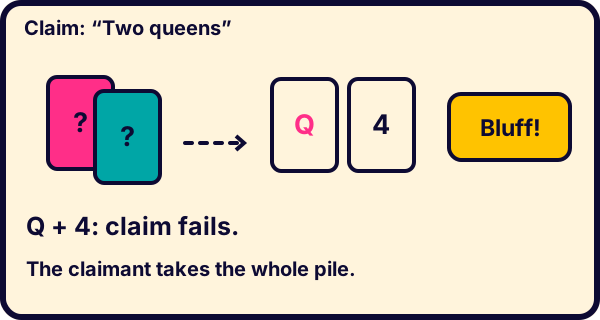
Bluff card game rules — claims and challenges
Learn one clear Bluff format: deal the cards, claim a rank, call a bluff and resolve the pile. Includes passing, final-card checks and variants.
Read the rules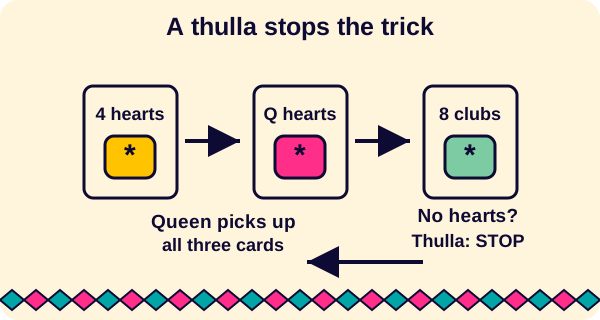
Card games · 3–8 players
Bhabhi rules — how to play Get Away
Learn Bhabhi with clear examples: follow suit, stop on a thulla, pick up the pile and handle the opening round and final-card exceptions.
Read the rules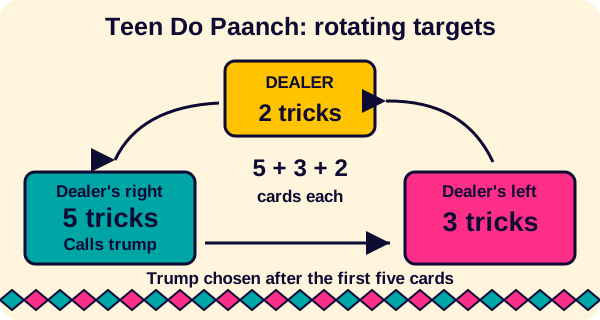
Card games · 3 players
Teen Do Paanch — three players, ten tricks
Learn 3-2-5 with a 30-card pack: who chooses trump, the two-three-five targets, following suit and exchanging cards after beating your quota.
Read the rules