
Paper games · Real-world rules
Dabba rules — dots, boxes and extra turns
ڈبہ
Also called Dots and Boxes, Dots game, Boxes.
Dabba is dots and boxes: players connect neighbouring dots with one horizontal or vertical line per move. Completing a small box earns a point and another move. When every box is claimed, the player with more boxes wins. Start with a small grid so the extra-turn rule becomes familiar before a long match.
At a glance
- Players
- 2
- Suggested age
- 6+ with guidance
- Allow about
- 10–25 minutes
- Where
- Indoor table, Classroom, Travel break
- Equipment
- Paper · Two pens or pencils
Jump to a rule
What you need
- Draw dots in straight rows and columns with enough space for initials inside each box. Use two pen colours if you like, but initials are enough to show ownership. A line's colour does not determine who owns the finished box.
- For a first game, use four rows of four dots. That gives nine small boxes. The number of dots is not the number of scoring spaces: a grid needs one more row and column of dots than the boxes between them.
Setup
- Agree who starts, choose each player's initial and count the available boxes. Keep the paper facing the same way for both players, or rotate it only between turns so nobody accidentally joins the wrong pair of dots.
- Explain one legal line before playing. It joins two neighbouring dots horizontally or vertically, with no dot skipped. Diagonals, long strokes across several gaps and tracing over an existing line are not new moves.
- Our standard game requires a player who completes a box to take the extra move. Do not pass that move to avoid giving something away. An undo is allowed only in an agreed teaching game, before the other person has acted.
How to play
- The starter draws one legal line between adjacent dots. If it does not finish a box, the turn passes. Early lines may look harmless, but each one changes how many sides nearby boxes already have.
- When your line supplies a box's fourth side, write your initial inside that box and add one point. You own it even when your opponent drew its first three sides. Take another move immediately.
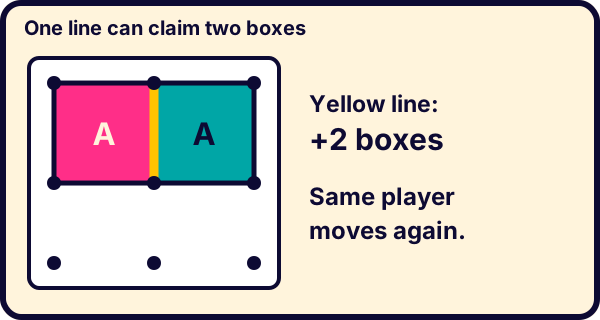
- Check both sides of a new line. A shared edge can complete two neighbouring boxes at once. Mark both, score two points and take one further move. The extra move is a turn to act, not one separate reward move per completed box.
- Keep moving while each new line completes at least one box. When you draw a line that completes none, your turn ends. This repeated extra-turn rule is why a chain of boxes can disappear in one visit.
- Finish when all possible boxes have initials. Count each player's boxes and check that the totals equal the number available. If one box is blank, inspect it before declaring a result; it may have been completed unnoticed.
Scoring / how to win
- Every small completed box is worth one point in the standard format. On our four-by-four-dot practice board there are nine points, so five boxes is enough for a majority. A larger board may allow an equal split.
- Example: Sara adds an edge that completes two boxes, then closes another with her extra move. She has scored three. Her next line completes no box, so Ali finally gets a turn. Count completed boxes, not the number of lines each person drew.
House rules & regional variations
- A chain is a connected run of boxes that can be taken one after another once an opening is offered. In a practice layout, leave three adjacent boxes with open shared edges, then examine which single line lets the next player start collecting them.
- You can use a rectangular board, such as three rows of five dots, without changing the basic rule. That board has eight boxes and can tie 4–4. Special bonus boxes or three-player games are house variants and need an agreed scoring sheet.
Tips & strategy
- Early in a game, look for lines that do not give a box its third side. Drawing a third side often offers an easy box to the next player. Later, every move may do that, so count the likely chain before choosing an opening.
- Taking every available box immediately is not always the strongest advanced move. To learn why, replay a small ending openly and compare two choices. You do not need a memorised chain formula to enjoy the game; start by following one extra turn correctly.
Safety & fair play
- Keep initials small enough that all four edges remain visible. Use plain paper instead of drawing on furniture or shared walls. If a line is ambiguous, clarify it while the pen is still down rather than claiming a different intention after the reply.
Questions before the first round
Who gets a box when both players drew its sides?
The player who draws the fourth side claims it. The earlier three sides do not reserve ownership.
Can one line earn two boxes?
Yes, if that line is the missing shared side of both. Score both, then take your extra move.
Can I draw diagonally?
No. Standard Dabba joins neighbouring dots only horizontally or vertically.
How many boxes do four rows of four dots make?
Nine: three gaps across multiplied by three gaps down. Count gaps between dots, not dots themselves.
Does a completed box always give another turn?
Yes in the standard game described here. Keep taking moves after scoring until you place a line that scores nothing or finish the board.
Sources & further reading
Try another game
Paper games · 2 players
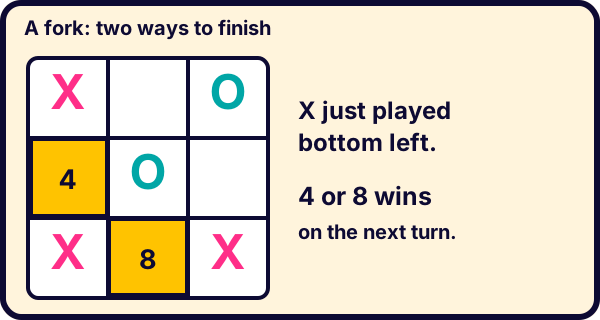
Kat Zero rules — crosses, circles and three in a row
Play Kat Zero on a 3×3 grid. Learn wins, draws, blocking and forks with a clear practice example, plus fair rules for a short match.
Read the rules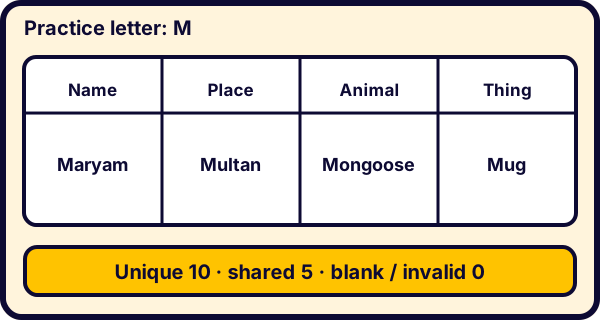
Paper games · 2–10 players
Name Place Animal Thing rules and scoring
Choose a letter and fill Name, Place, Animal and Thing. Includes 10/5/0 scoring, duplicate examples, Urdu rounds and fair answer checks.
Read the rules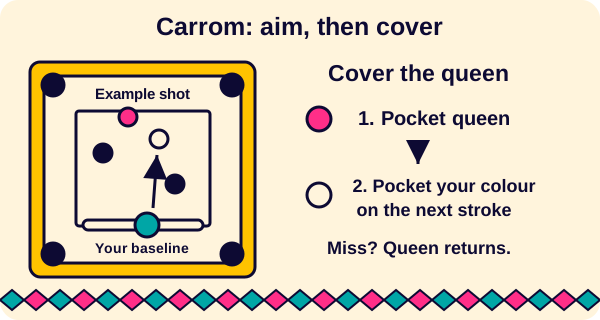
Board games · 2 or 4 players
Carrom rules — coins, queen and a clean finish
Learn carrom for two or four players: place the striker, pocket your colour, cover the queen, handle common dues and score a finished board.
Read the rules