
Card games · Real-world rules
Seep rules — captures, houses and scoring
سیپ
Also called Sweep, Sip.
Seep is a partnership card game where you capture matching values from the table and build houses for later collection. A clear table earns a sweep bonus. This guide explains the 100-card-point version. Punjabi 30-point Seep uses different scoring, so decide which version your group plays before anybody deals.
At a glance
- Players
- 4
- Suggested age
- 10+ with guidance
- Allow about
- 30–60 minutes
- Where
- Indoor table
- Equipment
- Standard 52-card pack · Table space · Score sheet
Jump to a rule
What you need
- Four players sit with partners opposite, using a pack without jokers. Leave room for loose cards, labelled houses and two captured piles. Keep houses open to inspection so a misplaced card can be corrected before the next turn.
- Write two score columns: card points and sweep bonuses. The number used to capture a card is not always its final score value. A hearts eight captures an eight-value group but contributes no card points in this version.
Setup
- Deal four cards to the player on the dealer's right and four face down to the table. The first player must bid a value from nine to thirteen that they hold. With no qualifying card, redeal. Reveal the table after the bid.
- The bidder's opening play must use the bid value: build a house of that value, capture with the matching card, or lay that card loose if neither is possible. Complete the deal in groups of four; everyone receives twelve cards in total, including the bidder's played card.
- Play anticlockwise. For capturing, ace is one, number cards use their number, jack is eleven, queen twelve and king thirteen. Announce house values clearly, and agree the match target and the treatment of special scoring before starting.
How to play
- Play one card each turn. It can capture equal-value loose cards or groups, help make a legal house, or remain loose when it cannot capture and is not used in a house. Captured cards go to your partnership's pile.
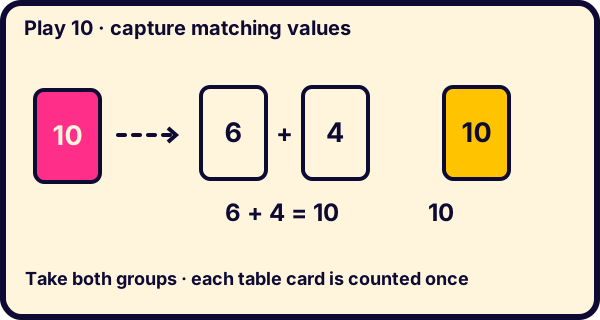
- For a worked capture, suppose the floor has a six, a four and a ten. A played ten takes both the loose ten and the six-plus-four group. Each table card can belong to only one captured group; it cannot be counted twice.
- Build a house only while retaining a matching capture card. For example, play a five onto a loose six to declare eleven, while keeping a jack in hand. A house is captured as a whole, never broken into smaller sums during collection.
- An ordinary house can be raised by another player using a card from hand while retaining the new matching card. A cemented house contains repeated sets of its declared value and cannot be raised. It can still be captured by a matching card; ownership does not make it private.
- Finish when all hands are empty. The last partnership to make a capture receives remaining loose cards. Count both captured piles before shuffling, then add sweep bonuses separately and update the running difference.
Scoring / how to win
- Card points: every spade scores its capture value; each other ace scores one; the ten of diamonds scores six. Together these make 100. A normal sweep adds 50, an opening sweep 25, and a final-play sweep adds nothing.
- Example: card points are 64–36, with no sweeps. The lead changes by 28. If the other team leads the next deal by 18, the earlier lead becomes ten. A 100-point lead wins a baazi; in this version, scoring fewer than nine total points in a deal loses the baazi immediately.
House rules & regional variations
- Punjabi 30-point Seep assigns points to a smaller set of cards and uses different sweep values. Some local versions differ even within that system. Select that complete scoring table rather than combining its bonuses with the 100-point cards.
- For a shorter learning session, agree a fixed number of deals and compare the net total. That is our suggested house match. If a tracker uses “first to 100 total points”, label it clearly: a raw total and a lead of 100 are different targets.
Tips & strategy
- Keep the card you need to collect your house visibly separate within your own hand. You do not show it to opponents; the separation simply prevents an accidental play that leaves your house unsupported.
- Before taking a pile, say the arithmetic aloud during a practice game. A quiet “six plus four, and the ten” lets everyone inspect the groups. Move to normal hidden-hand play once all four players can check a capture confidently.
Safety & fair play
- Play for points rather than money, and let the whole table verify the score. Do not silently change a card already accepted into a house. If an error cannot be reconstructed fairly, replay the deal instead of inventing a penalty.
Questions before the first round
Is a house safe from opponents?
No. Anyone with the matching value can capture it. A cemented house resists being raised, not being taken.
Does every captured card score points?
No. Capture value and scoring value are different. Count only the listed point cards in this version.
Does the last sweep earn fifty?
No. A sweep on the final play earns no bonus here. The first-play bonus is also different.
Can I combine a nine-house and a loose three with a queen?
No. A house must be captured at its declared value; it cannot be treated as one loose part of a larger sum.
Is the 30-point game wrong?
No. It is a separate established format. Agree which full scoring system you are using and keep it consistent.
Sources & further reading
Try another game
Card games · 4 players
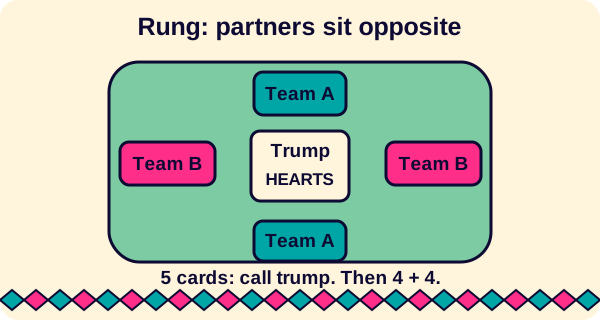
Rung rules — how to play Court Piece
Learn four-player Rung: partners, the five-card trump call, following suit, seven-trick wins and the difference between Single and Double Sar.
Read the rules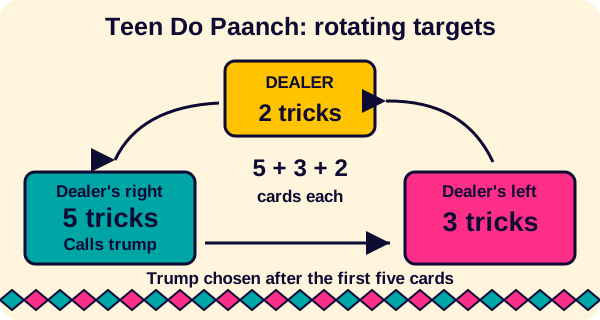
Card games · 3 players
Teen Do Paanch — three players, ten tricks
Learn 3-2-5 with a 30-card pack: who chooses trump, the two-three-five targets, following suit and exchanging cards after beating your quota.
Read the rules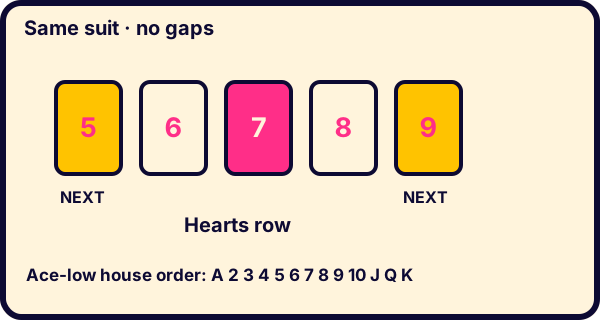
Card games · 3–6 players
Satti rules — build each suit from seven
Play Satti with suit rows starting at seven. Learn legal moves, passing, an ace-low family layout and a worked end-of-round score.
Read the rules