
Card games · Real-world rules
Rung rules — how to play Court Piece
رنگ
Also called Rang, Court Piece, Coat Pees, Single Sar.
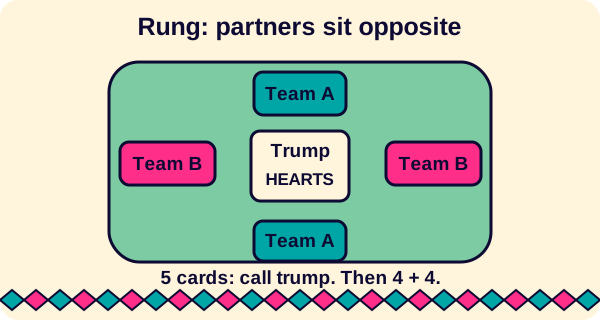
Rung, also called Rang or Court Piece, is a four-player partnership card game. A trump suit is chosen after the first five cards, and partners try to win at least seven of thirteen tricks. A trick is one card from each player, sometimes called a hand or sar. Learn the openly declared, Single Sar version below before adding Double Sar or hidden trump. Ages and session times are suggested guides.
At a glance
- Players
- 4
- Suggested age
- 10+; younger players with help
- Allow about
- 20–45 minutes
- Where
- Home, Family gathering, Shaded picnic table
- Equipment
- Standard 52-card pack without jokers · Paper and pencil
Jump to a rule
What you need
- Use one complete 52-card pack without jokers. Within each suit, cards rank A, K, Q, J, 10 down to 2. Have space for each team's won tricks and a simple record of deals and courts.
- Four players form two fixed partnerships, sitting opposite each other. Partners cannot show cards or secretly signal the suit they want. This guide follows anticlockwise dealing and play.
Setup
- Choose the first dealer. The player on the dealer's right is the trump-caller and cuts the shuffled pack. Deal five cards to each player, starting on the right.
- The trump-caller chooses one suit using those first five cards and announces it clearly. That suit is rung for the whole deal. Finish dealing in packets of four, then four, giving every player thirteen cards.
- Choose how long to play and what score you will record. Traditional court scoring is explained below. For a first lesson, you can instead use one point per won deal, clearly marked as a simplified house format.
How to play
- The trump-caller leads any card. Moving anticlockwise, each other player adds one card. If you hold the suit that was led, you must play that suit, even when another suit would win.
- If you have no card of the led suit, you may play a trump or discard a different suit. In this basic version, you are not forced to trump and do not have to beat an earlier card.
- The highest trump played wins the trick. If nobody played a trump, the highest card of the led suit wins. A high card from an unrelated non-trump suit cannot win merely because it is an ace.
- The winning player leads the next trick. Keep won tricks face down in countable groups so both teams can see the running total. Partners' tricks count together.
- A team reaching seven tricks wins the deal. You may stop there for an ordinary result, or continue if your agreed scoring needs all thirteen. Record the result before the cards are shuffled for the next deal.
Scoring / how to win
- A normal seven-trick majority wins a deal, not automatically a court. In the court system described by Pagat, seven consecutive won deals score a court; taking the first seven tricks of one deal also scores a court. A court resets the deal-winning streak.
- The next dealer comes from the losing side. If the dealer's team wins, deal passes right. If the trump-caller's side wins without a court, the same dealer repeats; if it scores a court, the dealer's partner deals next.
- For example, a 7–5 trick count wins the deal. A 7–0 opening is the stronger first-seven result. Agree session length and special bonuses beforehand; households differ on kot and all-thirteen rewards.
House rules & regional variations
- Double Sar does not collect every trick immediately. Tricks wait in the centre until the same player wins two consecutive tricks and collects the waiting pile. Two partners winning one each does not satisfy that condition. The last-trick winner collects the remaining pile.
- Hidden Rung keeps the chosen trump indicator face down until a permitted reveal. The moment trumps become active matters, so learn that variant's complete reveal rules before mixing it into Single Sar.
- Some groups use point tables for ordinary wins and courts, or special redeals for weak opening cards. Announce these before dealing. Do not assume an app's settings are universal Pakistani rules.
Tips & strategy
- Sort your cards by suit, with trump kept together. Before playing off-suit, check your whole hand: accidentally ignoring a suit you still hold changes the outcome for everyone.
- Count the high trumps already played. If your partner is winning a trick, spending another winning trump may waste a useful card. You still have to follow suit when possible.
- Correct an accidental wrong-suit play immediately, before the trick is closed. For a teaching game, replay the affected choices openly; competitive revoke penalties need agreement beforehand.
Safety & fair play
- Play for points and a friendly result, without money or punishments. Keep drinks away from the cards and let learners ask what a legal play means before the trick is completed.
Questions before the first round
Can we play standard Rung with three players?
This guide needs four in two partnerships. Teen Do Paanch is a separate three-player game and fits that group better.
Does any trump beat an ace?
A trump beats an ace of a different, non-trump suit. Within the trump suit itself, the ace is highest in this version.
Must I play trump when I cannot follow suit?
Not in the basic rules here. You may trump or discard another suit. A compulsory-trump rule would be a house change.
Is seven tricks always a court?
No. An ordinary majority wins the deal. The first seven unanswered tricks, or a qualifying run of won deals, can earn a court.
Do partners need consecutive wins for Double Sar?
The same individual must win two successive tricks. Alternating wins between partners do not collect the waiting pile.
Sources & further reading
Try another game
Card games · 3 players
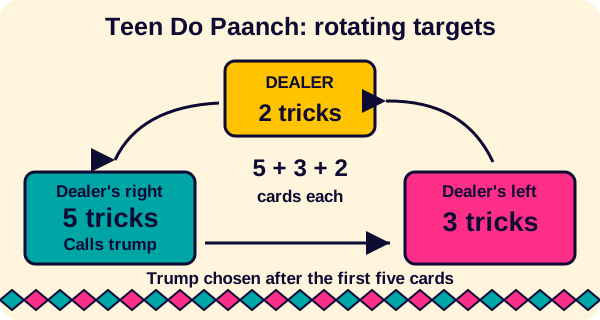
Teen Do Paanch — three players, ten tricks
Learn 3-2-5 with a 30-card pack: who chooses trump, the two-three-five targets, following suit and exchanging cards after beating your quota.
Read the rules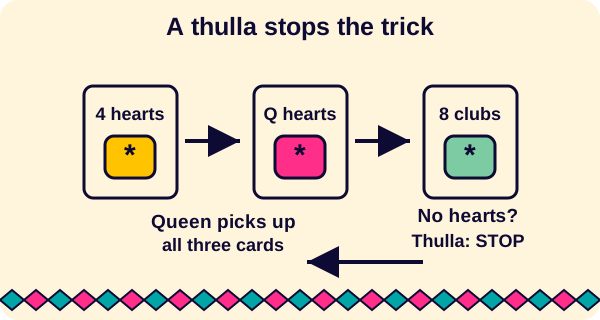
Card games · 3–8 players
Bhabhi rules — how to play Get Away
Learn Bhabhi with clear examples: follow suit, stop on a thulla, pick up the pile and handle the opening round and final-card exceptions.
Read the rules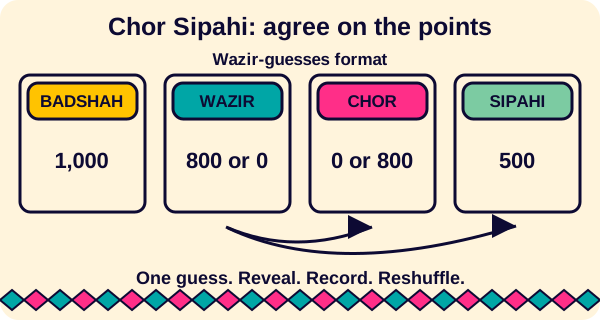
Party games · 4 players
Badshah Wazir Chor Sipahi — four chits, one guess
Make four secret role chits, let the Wazir find the Chor, and keep clear scores. Includes the Sipahi-guesses variant and larger-group options.
Read the rules