
Street & outdoor · Real-world rules
Stapu rules — how to play hopscotch
اسٹاپو
Also called Stapoo, Stappu, Hopscotch.
Stapu is a hopping game played on numbered squares. Toss a marker into the next target square, travel through the course without stepping there, then collect it on the return journey. Complete each target in order to finish. Stapoo layouts vary; this guide uses a ten-square course with single and paired spaces. The suggested age, group size and session time can be adjusted to your players.
At a glance
- Players
- 1–6
- Suggested age
- 5+ with supervision
- Allow about
- 10–20 minutes
- Where
- Dry courtyard, Playground, Clear indoor floor
- Equipment
- Chalk or removable floor tape · Flat marker or beanbag
Jump to a rule
What you need
- Draw the course with chalk outdoors or removable tape on a suitable indoor floor. Each square needs enough room for a player's whole foot. Leave clear space beyond both ends for waiting and turning.
- Use a flat marker that stays where it lands, or a small beanbag. Avoid a sharp stone or a hard object that rolls under somebody's foot. One shared marker is enough if players remember their own next target.
Setup
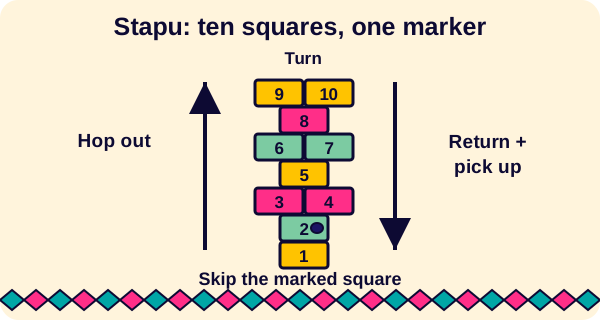
- Number ten connected squares from the starting end. Our diagram uses single squares 1 and 2, a pair 3–4, single 5, a pair 6–7, single 8 and a final pair 9–10. Another clear layout works if everyone follows the same route.
- Explain where one foot and two feet belong. A single square takes one foot; a side-by-side pair normally takes one foot in each space. A square holding the marker is skipped, including when it is part of a pair.
- Choose a playing order and decide whether everyone gets one attempt per turn or continues until a mistake. This guide uses one target attempt per turn so nobody waits through an entire successful course.
How to play
- Stand behind the starting line and gently toss the marker into square 1 on your first turn. It must land inside the target rather than on a line or another square. If it misses, pass the marker to the next player.
- Hop onto the first available square, skipping the marker's square. Continue through the numbers, using one foot on single spaces and both feet on a clear paired row. Keep your feet inside the lines.
- Turn at the far end where the course provides room. Return along the same numbered route. Slow down before the marker rather than jumping directly onto it.
- Stop on the space just before the marker and pick it up while keeping your balance. In the standard hopping version, do not put an extra foot or hand on the ground to help. Then finish the route back to the start.
- A clean trip completes that target. On your next turn, aim for square 2, then 3 and so on. A missed toss, line touch or extra step ends the turn; retry the same target next time.
Scoring / how to win
- The first player to complete the return trip for square 10 finishes the course. Do not count simply landing the marker in 10 as a win: the hopping and return pickup still need to be completed.
- For an equal-turn house finish, let the other players complete the current round of turns. Anyone who also completes 10 shares the win. For solo play, count completed targets or try the course without recording a score.
House rules & regional variations
- Six- or eight-square stapu courses suit a shorter space. Some layouts include a rest area or a semicircle at the top. Point these out before play, because a rest space changes where both feet are allowed.
- For younger players, permit walking or a two-foot jump through the course and allow both feet down for pickup. Keep these adaptations consistent for that player rather than calling the same movement a fault later.
- Some groups continue immediately to the next number after a successful trip. Others use a hopping-only course without a marker. Timing a race is another variation, but balance and a clear landing space should come first.
Tips & strategy
- Throw the marker gently. A hard throw can bounce out of a square that looked easy to reach. Take a moment to check the target before tossing, especially when your last completed number differs from your friend's.
- Practise the return pickup separately. Stand in a single square, bend slowly and lift the marker without rushing the next hop. A paired row can offer a useful pause when both spaces are clear.
- Keep waiting players behind the starting line. If a sibling walks into the course, stop and replay the interrupted part rather than trying to hop around them.
Safety & fair play
- Use a dry, flat surface away from traffic and steps. Remove loose stones and test whether tape or chalk has made the surface slippery. Leave space between courses and take turns; nobody should run through an active course.
Questions before the first round
What happens if the marker touches a line?
The throw misses in this version. End the turn and retry the same target next time; do not move the marker into place by hand.
Can I put both feet down?
Yes, on an empty paired row. Single squares use one foot unless you have agreed a walking or two-foot adaptation.
Do I restart from square 1 after a mistake?
No. Keep the targets you have already completed and retry the unfinished target on your next turn.
What if the marker occupies one square of a pair?
Skip that square and land only in its clear partner. Do not put a foot beside the marker in the occupied space.
Can stapu be played alone?
Yes. Follow the same sequence at your own pace. The course works as a balance challenge without an opponent or timer.
Sources & further reading
Try another game
Street & outdoor · 4–16 players
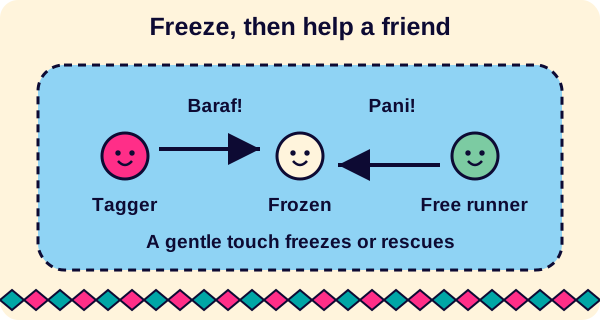
Baraf pani rules — how to play freeze tag
Play baraf pani with clear tagging, freezing and rescue rules. Includes a simple round format, fair rescues and walking adaptations.
Read the rules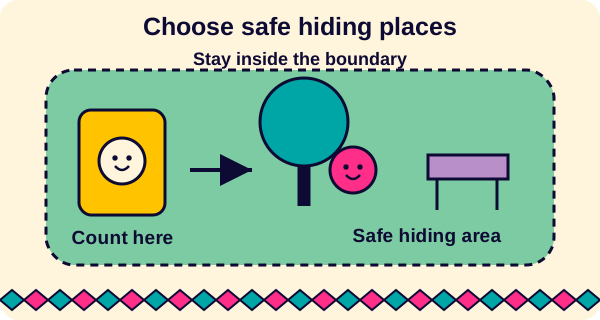
Street & outdoor · 3–12 players
Chupan chupai rules — how to play hide and seek
Set up chupan chupai with safe hiding places, a clear count and fair turns. Learn the basic game and the optional home-base version.
Read the rules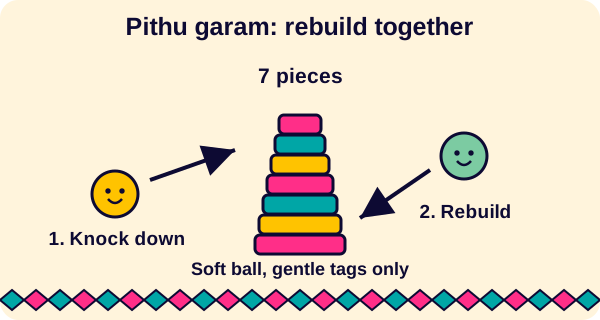
Street & outdoor · 6–14 players
Pithu garam rules — how to play seven stones
Learn pithu garam with a soft ball: stack seven pieces, knock them down, rebuild, tag safely and agree the local rules before playing.
Read the rules