
Street & outdoor · Real-world rules
Pithu garam rules — how to play seven stones
پٹھو گرم
Also called Pittu garam, Pitthu, Seven stones, Lagori.
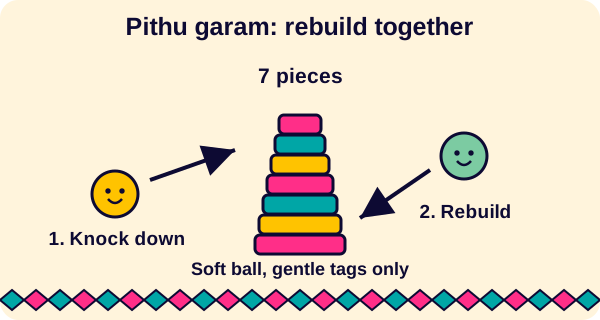
Pithu garam has two jobs: knock down a small stack, then rebuild it before the other team puts your players out with a ball. The same family of games is called pittu, pitthu, seven stones or lagori. Piece counts and tagging rules vary. This is a soft-ball, seven-piece house format for a mixed-age group, not a tournament rulebook. Ages and times are suggested planning ranges.
At a glance
- Players
- 6–14
- Suggested age
- 7+ with adult supervision
- Allow about
- 15–30 minutes
- Where
- School playground, Open ground, Enclosed courtyard
- Equipment
- Seven flat lightweight pieces · Soft foam or cloth ball · Boundary markers
Jump to a rule
What you need
- Find seven flat pieces that stack without sharp edges. Lightweight wooden discs or foam blocks are a useful substitute for stone. Test the tower before the game; a stack that falls without a touch will cause arguments.
- Choose a soft ball that is comfortable to catch and cannot hurt at a gentle throw. Mark a central stack area, throwing line and outer boundary. Leave space beyond the line so throwers can step back without meeting spectators.
Setup
- Make two equal teams. One knocks down and rebuilds; the other fields and tags. Choose the first throwing team with a toss, then swap after every round so both sides get the same number of chances.
- Agree a throwing distance suited to the group. Start close enough that a younger player can reach the tower with a controlled throw. Use the same line for both teams; there is no single street-game distance used everywhere.
- For this house format, give the team three throws in total to knock down the stack. A direct safe below-knee ball hit puts a rebuilding player out. Set a round time if you need one, and practise the stop signal.
How to play
- A thrower stands behind the line and aims at the stack while the fielding side waits clear of the throw. If all three team attempts miss, the round ends and the teams exchange jobs.
- Once at least one piece falls, the rebuilding team can enter the stack area. Fielders collect the ball. A player who is out leaves the active space and waits beside the boundary, without blocking a throw.
- Rebuilders work together to replace the pieces. They can distract fielders by moving into open space, but must stay inside the boundary. Nobody may cover the tower with their body or hold an opponent.
- Fielders pass to a teammate or attempt a gentle below-knee tag with the soft ball. In this starter format, the ball carrier stops to throw; running with the ball and chasing someone at arm's length is not allowed.
- The rebuilding team finishes by standing all seven pieces and calling 'Pithu garam!' The tower must hold without a hand supporting it. If every rebuilder is out first, the fielding team wins that round.
Scoring / how to win
- Award one round point to whichever side completes its task: a successful rebuild or all rebuilders out. After both teams have thrown the same number of rounds, the higher total wins. A drawn match can simply stay drawn.
- If you use a timer, state the result of an unfinished round in advance. A useful house choice is a fielding win when time runs out. Do not introduce a timer halfway through a difficult rebuild.
House rules & regional variations
- Seven pieces give the game its English name, but Pakistani descriptions also record different stack sizes. Use the agreed number consistently. Reducing the stack for younger children is a practical adaptation.
- Some groups give each thrower several attempts or declare a thrower out when the initial ball is caught after a bounce. Others require a finishing gesture or repeated call. These additions change the game; teach them before the first throw.
- A gentler version uses a hand tag while holding the ball instead of throwing at people. Another keeps every player active and gives the fielding team a point for a tag. Neither is the default elimination format above.
Tips & strategy
- Give the stacker room. Two players reaching for the same piece can knock down a nearly complete tower. One can rebuild while teammates draw fielders away with movement.
- Fielders should pass toward the next likely gap, rather than all following the ball. Rebuilders should notice where the ball is before bending over the stack.
Safety & fair play
- Use gentle below-knee throws only, with no face, chest or head shots. Sharp tile fragments, hard balls and roadside play are unsuitable. Stop play if someone falls; reset the ball before continuing.
Questions before the first round
Must there be exactly seven stones?
Seven is a common format, but regional versions use other counts. This guide uses seven lightweight pieces and treats changes as house rules.
Can the fielders run with the ball?
Not in this starter format. They stop and pass or throw. Some local games differ, so agree the rule before anyone starts chasing.
What if the completed tower falls straight away?
It must stand without support before the finish call counts. If it falls while a hand still holds it, the rebuild is incomplete.
Can one player finish after teammates are out?
Yes. The remaining player can still rebuild the stack. The fielding side needs to put every rebuilder out to end the round that way.
How do we settle a disputed hit?
Stop immediately and ask the agreed referee. If the view was blocked, replay the disputed moment from a clear reset rather than arguing while the tower moves.
Sources & further reading
Try another game
Street & outdoor · 4–12 players
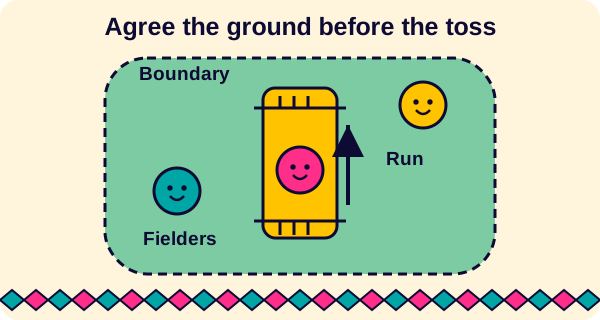
Gully cricket rules — how to play gully cricket
Settle gully cricket rules before the toss: teams, overs, one tip one hand, roof shots, last-man batting and a simple score example.
Read the rules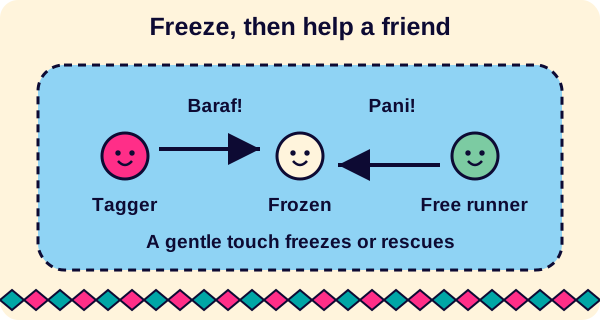
Street & outdoor · 4–16 players
Baraf pani rules — how to play freeze tag
Play baraf pani with clear tagging, freezing and rescue rules. Includes a simple round format, fair rescues and walking adaptations.
Read the rules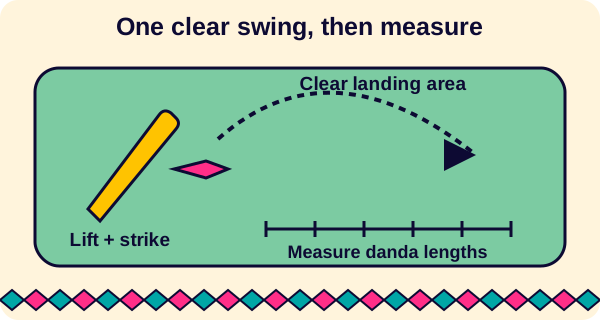
Street & outdoor · 2–10 players
Gulli danda rules — how to play the two-stick game
Learn a clear gulli danda starter format, distance scoring, catches and local return-throw rules, with essential space and safety notes.
Read the rules