
Culture
Basant and the rooftops of Lahore: a friendly history of kite flying
Basant is a spring festival associated with Punjab and, especially in Lahore, with kite flying. Its familiar images are yellow clothes, paper kites and people watching the sky from rooftops. Understanding that scene means looking beyond the flying: there are makers, neighbourhoods and shared memories behind it. The history is richer than a single origin story or a date on a festival poster.
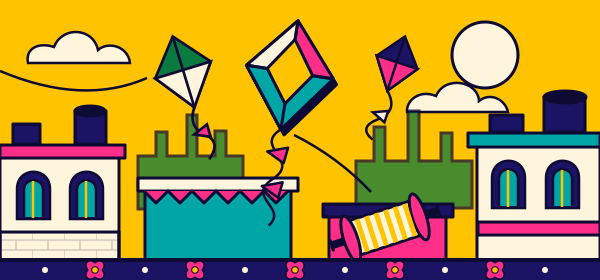
A spring tradition without a neat starting date
In his University of the Punjab study, researcher Amjad Parvez connects Basant's name with spring and describes its long association with kite flying. He also notes uncertainty about exactly when Lahore became the centre of these celebrations. That distinction matters. A long-established tradition can have a documented history without having one provable inventor or first festival.
Spring celebrations and kite traditions belong to a wider South Asian setting. Lahore's particular story grew through its own streets and communities. We do not need to assign every custom to a single ruler or repeat an attractive legend as settled fact to appreciate that story. When a source describes an origin as a belief or a tale, it should stay labelled that way.
Why the old city belongs in the picture
The Walled City of Lahore Authority's guide to the historic gates records a useful everyday detail: kites and twine are among the goods associated with the area inside Mori Gate. It places the trade alongside the area's other markets. That makes the kite part of an actual working city, rather than a decoration added only when a camera arrives.
A rooftop photograph gives you one view of that city. A shopfront or a maker's workbench gives another. Look for both when exploring an archive. Where are the people getting their equipment? Who is watching rather than flying? What is being sold nearby? Those questions help a family album or old newspaper photograph tell a fuller story than the sky alone.
Androon Lahore means inner Lahore. You will hear the phrase in discussions of the old city and its life. It isn't a promise that every rooftop is a public viewing platform. A historic neighbourhood is still somewhere people live, work and need privacy.
Recent history: interruption and a 2026 return
Basant's recent story includes a long interruption to public kite-flying celebrations after serious accidents involving dangerous string. In February 2026, Associated Press reporters documented the festival's return in Lahore, including families gathering on rooftops and warnings about hazardous string. The Punjab government's own announcement listed the festival dates as 6–8 February 2026.
These are dated events, not an annual schedule for the future. An article or photograph from that weekend tells you what happened then. It cannot tell you whether flying is permitted on another day. That is why this guide separates the cultural history from advice about checking current arrangements.
For someone who grew up hearing about Basant during the interruption, photographs of the return may be their first view of a large celebration. For someone older, the same scene may recall an earlier period. Both perspectives belong in a conversation about how a city remembers its festivals.
The kite is a small piece of skilled making
Parvez's study documents paper-and-bamboo construction and several named kite forms, including gudda, guddi and patang. It also discusses the care needed in shaping the frame and attaching the paper. A familiar silhouette may look simple from far away, but symmetry and weight matter to an object that has to respond to moving air.
If you're looking at kite art, start with the outline. Is it angular or rounded? Then look at the colour panels and where the frame supports the paper. This is an easy way to appreciate the design without treating the kite as merely a bright spot in a festival photograph. You can sketch a paper-kite pattern indoors, with no string or flying involved.
For a shared drawing activity, give everyone the same empty outline and choose different colour combinations. Compare how a narrow stripe changes the shape's appearance next to a large block of colour. This is our suggested art exercise, not a claim about a traditional competition or a historical workshop.
A few words you will hear around Basant
Patang is the familiar word for a kite, although makers also use more specific names for particular shapes. Dor means the string. Chhat means a roof or rooftop. Ustaad is a master or skilled teacher; in kite culture, the word recognises experience that a beginner cannot acquire simply by owning equipment.
Kaat di is the celebratory call associated with a rival kite being cut loose. Roman spellings vary, so you may see the sound written differently. In our game, the phrase accompanies a bonus for meeting a rival kite. It is a playful reference to that vocabulary, not an instruction to use cutting string outside.
If an older relative uses another word for a kite or reel, ask what it means in their own neighbourhood. Record the spelling and their explanation together. A personal recollection is valuable as a recollection; you don't have to turn it into a claim that everyone in Pakistan uses the same term.
The safety history belongs in the story too
The Punjab government's festival information acknowledges safety concerns and restrictions as part of Basant's recent history. News photographs of a celebration should never be read as permission to fly anywhere at any time. Rules and authorised arrangements can change, so check the current local authority information for the place and date involved.
Metallic and abrasive cutting strings can seriously injure people and wildlife. Do not use glass-coated or metal string. Keep any permitted flying away from roads and power lines, and never climb or reach towards electrical equipment to recover a kite. Roof edges and chasing a loose kite into traffic create separate risks. An adult should supervise children's activities in a suitable location.
These precautions do not turn an unsuitable place into a safe one. For a family activity without those hazards, make a decorative kite to hang indoors, draw rooftop scenes, or play a kite game on a screen.
A little Lahore in Patang Baaz
Patang Baaz borrows the rooftops and colour of this visual world for a small arcade challenge. Tap to tug the smiling kite upwards, leave room for it to fall and steer through the openings between buildings and hanging wires. The city changes from day to dusk to night as your score grows.
The animated obstacles and bonus kites follow game rules. They do not model real kite flying or recommend real-world behaviour. What we wanted to keep was the quick delight of noticing a colourful shape against the sky. Try a flight through the link below, then come back to the sources if you'd like to explore the craft and city behind the illustration.
Sources and further reading
- Amjad Parvez, University of the Punjab: Kites, Kite Flying and Kite Fighting in Punjab (2018)
- Walled City of Lahore Authority: historic gates and Mori Gate's markets
- Punjab Portal: festivals and Basant
- Punjab Portal: the announced 6–8 February 2026 festival dates
- Associated Press: reporting from Lahore's February 2026 Basant return
- Associated Press of Pakistan: Basant safety arrangements, February 2026